
Wellness is defined as “the state of being in good health, especially as an actively pursued goal.”(Oxford Dictionary) I’m sure we are all actively pursuing good health, but this is a goal that can take a while. Practicing mindfulness is a process, but it is one that we can all get to.
Many adults have experienced symptoms of anxiety at some point as a reaction to uncertainties and stressors. Common stressors can include a lengthy pandemic, increased living costs, job insecurity, estranged family relationships, major life changes, and health concerns.
Anxiety is highly treatable, yet only 36.9% of adults suffering receive treatment. Children also experience stressors from schoolwork, peer pressure, negative family dynamics, etc. Social media is popular these days and may negatively affect mental health among young people. The lifestyles shown on social media and the fear of missing out (FOMO) are connected to anxiety and ironically cause a sense of loneliness in a noisy virtual world.
Stress is a Natural Reaction, but Anxiety Disorder is Not
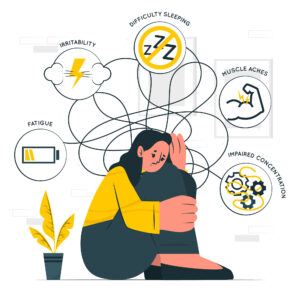
It is quite normal to worry about something from time to time, particularly in stressful situations. Anxiety is a natural reaction and can help us cope with dangers. But when our worries become more extreme, they result in a medicalized form. Anxiety disorders consist of intense fears with a more severe physical response that can interfere with a person’s daily life.
The physical symptoms include:
- Shortness of Breath
- Racing Heart
- Excessive Sweating
Many people experience these symptoms. After losing my beloved father, I experienced these mind-body symptoms. Walking out of the mud of anxiety brought me new insights and new life. I will share my experience in a later blog.
There are 5 major anxiety disorders:
- Generalized Anxiety Disorder
- Obsessive-compulsive Disorder (OCD)
- Panic Disorder
- Post-traumatic Stress Disorder (PTSD)
- Social Phobia
According to the National Institute of Mental Health, an estimated 19.1% of US adults (almost 1 out of 5) suffered from an anxiety disorder in the past year. Generally, anxiety disorder is the most common mental illness in the US, affecting 31.1% of the population at some time in their lives.
Why do We Have So Much Anxiety?
Anxiety, the illness of our time, comes primarily from our inability to live in the present moment.
Thich Nhat Hanh
From the quote above, Thich Nhat Hanh, one of the most renowned Zen masters, points out that anxiety comes primarily from our inability to live in the present moment.
Let’s take a close look at ourselves. Our minds are often attached to the past, bringing up feelings and emotions from what has happened previously. Or sometimes, we worry about what will happen in the future, which brings thoughts of insecurity and fear. Even when we are working on something, in the moment, our minds may still wander somewhere else. When our minds are absent from the current moment, we cannot enjoy and are easily prone to anxiety.
Life is becoming more and more fast-paced. Multitasking has become a necessity for many people. We are very easily distracted by numerous sights, sounds, thoughts, or tasks. But our human mind is made to focus on one thing at a time. Absence from the present moment is one of the main factors for burnout and anxiety.
The Majority of Our Worries Never Happen
Interestingly, the vast majority of our worries (around 95%) would never come to reality. Still, we gear up 100% of our energy worrying, fearing, and stressing. We believe something threatening is coming our way based on our own perception.

Excessive worries and anxiety do not bring a good outcome. It will not help us solve the problems or difficulties. On the contrary, they may push us to the edge of strong anger and fears that invites more trouble. Despite knowing this, many of us spend more energy dealing with our emotions than actually setting out to solve the problem.
Can Mindfulness Practices Be a Solution?
A Mid-day Check-in Practice
At Plum Village, Thich Nhat Hanh initiated the great “The Bell of Mindfulness” mechanism to remind everyone to be mindful. The bell rings several times during the day. No matter what you are doing at the moment, such as carrying on a conversation, working on your tasks, etc., everyone pauses and goes silent when a bell sounds. Taking moments throughout the day to connect with your body, and reflect on your present moment, can significantly increase happiness and ease.
Try implementing a mid-day check-in moment. During noontime, pause whatever you’re doing, be silent, relax, and enjoy the moment. Let us know how it goes.
Check out MyCHN’s Wellness Program.

Dr. Jiali Sun
Dr. Jiali Sun is the Wellness Coordinator for the MyCHN Wellness Program. She has a well-rounded healthcare background as a former gastroenterologist physician with a Ph.D. in Immunology and a Master of Public Health in Healthcare Management. Dr. Sun is a lifelong learner and she is grateful for the opportunity to walk along with everyone to uncover the healing power inside each of us.