
Summertime means more time outside, and more time outside means more activities that get you sweating. It’s the perfect time for your kids to do more outdoor activities. But what you want to consider and pay attention to is their hydration. Even if your child is not old enough to play outside, pay attention to how hydrated they are, and watch out for the tell-tale signs of dehydration.
Just like adults, children, including infants, need to be hydrated. Did you know that infants and kids are more at risk of dehydration? There is a simple explanation for this fact. It turns out that their body surface in general, in relation to their overall body weight, is more than adults. With that being said, when they lose fluids, they quickly get dehydrated.
So, let’s continue with the example of your child going outside for an activity. If your child is outside while it is 95°F or more, not drinking any hydrating fluids, they are sure to get dehydrated fast. This is because the body temperatures of active children do not adjust to temperatures of 95°F or more as well as adults.
Adults sweat more to regulate heat, but it is not the same for children. Instead, what happens is that kids produce more heat and sweat less. Essentially this means that their bodies don’t cool down as fast. And if they are not drinking any hydrating fluids and replenishing themselves to keep properly hydrated, the result is a dehydrated child.
Symptoms of Dehydration
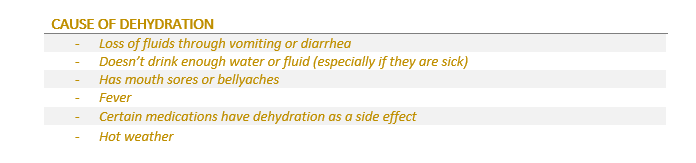
You have a clue about some of the causes of dehydration, but it is even more important to know what to look for. Knowing how to check for dehydration in a child is important and can be of great help.
Some of the most common and easiest things to check for include no tears when crying, dry sticky mouth, very dark urine, and child being lethargic (more tired than usual). In addition, there are symptoms you can check for extreme dehydration. Extreme dehydration is different from mild or medium dehydration, and so are its symptoms. Keep in mind it’s important to pay attention to all symptoms because you don’t want them to get to a severe level.

Some of these severe dehydration symptoms include:
- Extreme thirstiness
- Child is lethargic/tired more than usual
- Irritable, drowsy, or confused
- Passes out
- Cold in the hands and feet
- Breathing faster than usual or has a faster heart rate
Signs of Dehydration in Infants
In infants the signs you are looking for a similar, but there are some differences. So, let’s look more into it.
Pay attention to their hydration level if they are not eating enough. You’ll notice that they don’t have as many wet diapers. They are dehydrated if they have fewer diapers than usual or haven’t urinated for more than 6 hours. In addition, if they have dry eyes or you can tell that their mouth is very dry, they are dehydrated.
In extreme cases of dehydration, you might notice that they have a sunken fontanelle, sunken eyes, and/or cheeks. If you see that the top of an infant’s head is flat or sunken, this is a sunken fontanelle. They need to be hydrated as soon as possible this is considered an emergency. So, it is recommended to visit the emergency room as soon as possible. This stays true; if you notice that their eyes or cheeks are sunken, you also want to go to the emergency room.
Why Dehydration is Dangerous in Infants
It is dangerous, especially for infants, to be dehydrated. The main reason for this is that a specific “ingredient” in the fluids they get keeps their body maintaining a balance of their internal and external bodily fluids. This ingredient is called an electrolyte. Electrolytes allow their bodies to function correctly. So, if this is lacking in an adult’s body, you can only imagine what it would be like for infants and children under 12 years old.
Hydration Check & Prevention Remedies
Now, you have the symptoms you can look for and the possible causes of dehydration. So, let’s do a hydration check. This hydration check is a list of things you can do to rehydrate your child in addition to what you can do to keep them hydrated.
Prevent Child Dehydration by:
- Have them take water breaks. They may or may not tell you they’re thirsty, so have them drink water.
- Making sure they were proper clothing if they are being active & even if they are not active.
- Introducing them to the habit of hydrating during activity and after activity
- Watching their urine closely. Check to see if the color of their urine has gotten darker.
Hydration treatment options for babies younger than 12 months Include breast milk, ORS, or formula. Note that it is important not to stop breastfeeding or giving formula. If there is a case they are vomiting, giving them in smaller portions is fine. In addition, if they drink formula, do not dilute it, and continue feeding the same amount properly.
Hydration treatment options for children older than 1 year include breast milk and formula if they are still taking that. In addition, you can add water. If they are vomiting or have diarrhea, you can stop the milk, and that should help.
Check the table below for the ounces of fluids you can give for rehydration

*Table from Nationwidechildrens.org- Dehydration*
Pedialyte vs Water
Pedialyte and water are both oral solutions for dehydration. In fact, they are universal solutions for both children and adults. In the case of children, you might be thinking about which is best or the most effective. This question doesn’t have one solid answer because the truth is that they are both great remedies. In the cases of mild dehydration, parents can opt-in for Pedialyte. This is extremely helpful if a child is losing fluid quickly, for example, if they are vomiting or have diarrhea. But you can also give a child water in this case as well, and it will have the same effect.
The main difference between water and Pedialyte is that Pedialyte has electrolytes. As we mentioned before, children need more electrolytes. It’s best for them to get it from this oral solution than fruit juices or sports drinks. This is because those types of drinks have a lot of sugar and will not do the job of hydrating.
So, you can choose either solution. The most important thing is making sure that the kids are hydrated. Check the table below to see how much Pedialyte you should give a child for rehydration.

*Note: For infants, it’s best to spoon or syringe feed
Go forth and check to see if your child is dehydrated. Keep these tips as they play and grow and ensure they are always hydrated.
Resources
Webmd.com- Prevent Dehydration in Children
rch.org- Kids Info- Dehydration