The month of November raises awareness for Alzheimer’s disease: a brain disorder that affects memory, thinking, and language skills. Scientists don’t fully understand what causes Alzheimer’s disease, but Alzheimer’s prevalence is notable as 5.8 million Americans lived with the disease in 2020. The high amount of people living with Alzheimer’s called for organizations to form and raise awareness about Alzheimer’s disease. The importance of education about Alzheimer’s becomes essential when considering its most significant risk factor is aging.
Alzheimer’s: Facts and Symptoms
With one of the known risk factors being aging, many consider Alzheimer’s a normal part of aging. Alzheimer’s, however, is not considered a normal part of aging and progressively worsens over time. The worsening of its symptoms causes the livelihoods of those who live with the disease to become problematic. This is because common symptoms of Alzheimer’s are:
- Memory Loss that disrupts daily life (i.e., forgetting where the local grocery store is)
- Confusion about time and place
- Challenges in planning about or solving problems
- Struggling to complete familiar tasks (i.e., brushing teeth)
- New problems with words in speaking or writing
- Changes in mood or personality
These symptoms alter the capabilities of anyone to maintain their daily routines in life. As such, awareness must be raised regarding the symptoms and the progression of Alzheimer’s disease.
Aging and Alzheimer’s
The symptoms of Alzheimer’s progressively become noticeable worse. With no known cure, understanding what to expect as the disease progressive provides caregivers and family members with an opportunity for what to expect. The progression of Alzheimer’s disease has been broken down by the National Institute on Aging into three categories: mild, moderate, and severe.
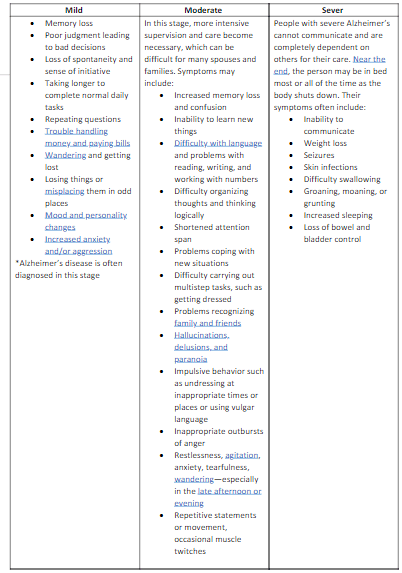
Alzheimer’s disease can be overwhelming for both the caregiver and the patient. The various symptoms and progression of the disease are an expensive toll as it requires the commitment of a caregiver. Many caregivers are family members, which affords an opportunity for personal fulfillment as they care for a loved one and strengthen their familial connection. However, the emotional and physical burden cannot be stressed enough. This month, be sure to thank caregivers and visit the resources below to see how you can support caregivers as they support those with Alzheimer’s disease.
Resources and References:
https://www.cdc.gov/aging/aginginfo/alzheimers.htm#AlzheimersDisease
https://www.alz.org/alzheimers-dementia/10_signs
https://www.nia.nih.gov/health/what-are-signs-alzheimers-disease